
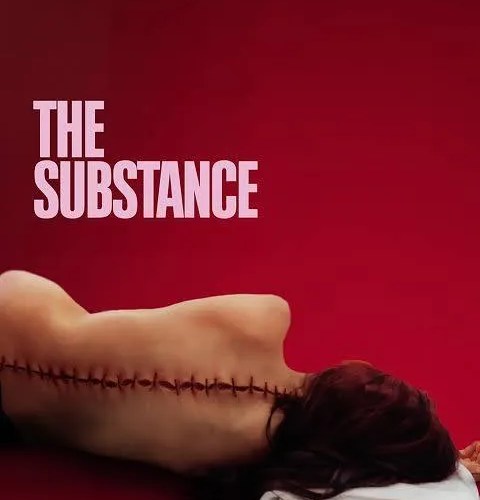

(By Hella Ahmed) The Substance is an intriguing film in many aspects. Not only does it nearly perfectly represent reality—albeit in a slightly fictionalized, not grotesque, manner—it also allows us to experience the illustrated agony of modern flesh, specifically its beautification dilemma, through a character played by an actress known for past struggles with the notion of youth, exacerbated by her experiences with Botox and plastic surgery. These issues were perhaps magnified by public comments on her personal life rather than by her own free choices regarding her appearance.
Demi Moore’s role in The Substance is often hailed as her big return to the screen. Is this because her face appears less damaged now? Or does this role serve as a form of redemption, confession, and proof of healing? Or perhaps it’s an expression of indifference (« I just don’t care about all of this, everything, and nothing »)? Moreover, can we call it recovery if better products and procedures are merely available to enhance appearance? If assistance is no longer harmful and works effectively, as seen with Demi’s new glow, perhaps the rejuvenation industry isn’t such a significant issue after all. However, the psychological scars from past experiences remain; they might be invisible, but they are not invincible. Well-being could still be within reach.
Why should we view the pursuit of beauty and youth as problematic or as a sickness? These are personal choices, but can we always make wise decisions? Can we control the influences around us? Do we truly have our best interests at heart? Is progress always the best path forward?
Progress does offer better options, and the results can be spectacularly positive—that’s my opinion, and I’m not endorsing any product or procedure. Personally, I’ve never been much for beauty products; I haven’t even used many rejuvenating creams, which I should probably address ASAP since time waits for no one. Maybe in the future, I’ll become obsessed with rediscovering youth, tormented by not having made an effort to preserve it. I always imagined aging gracefully in a seaside villa, delicately applying beauty creams to my beautifully toned body.
Currently, there’s no villa (though I promise myself and the envious critics watching me with psycho-like scrutiny that there will be one soon), and my body has changed due to the extreme fatigue from life’s daily challenges. I’m ready to seek beauty assistance. I need a trainer since gym visits aren’t easy, and my motivation wanes half the time; life’s delusions make me critical and impatient. A few fillers would be welcome; small touch-ups are all I need.
Many might start with enhancements, only to become dependent on fillers. Some know when to stop, while others, once they enter the magical world of cosmetic surgery, lose control, and, of course, money plays a crucial role—can you afford rejuvenation? Some dedicate their lives to earning money for extreme, sometimes damaging transformations. I use ‘damaging’ respectfully, acknowledging that they might be very happy with the results, and it’s not my place to judge.
The Substance centers on a youth serum, self-esteem, and the hunger for fame. Its ending, featuring an Elephant Man-like scene, clearly critiques the monstrous effects of Botox and fillers on once-beautiful faces. Is body dysmorphia more common nowadays? Knowing that with money and procedures, one can look much younger, many might feel abnormal when facing their reflection. This might not be a big deal for everyone or all the time, but in our modern world, it’s a collective experience; youth matters, and a spectacular industry caters to those who can afford it.
Hella Ahmed © All rights reserved – Find my books on Amazon




 Santé Mentalité inc.